Showing posts with label Fantasy. Show all posts

Saturday, April 19, 2008

Haunted Castle on Hallows Eve


Haunted Castle on Hallows Eve
Written by: Mary Pope Osborne
Illustrated by: Sal Murdocca
Published by: Random House Children's Books in 2003 in NY
Genre: Fantasy
Age: Grades 2-3

Summary: In this book Jack and Annie receive another letter from Merlin. This time he wants them to go back to Camelot and restore order to an old castle. In this adventure they take a sorcerer, named Teddy, who is Morgan's apprentice, along for the journey. Together the three of children discover a "haunted" castle and discover that the Diamond of Destiny was stolen form this family, which turned them into ghosts. Jack, Annie, and Teddy's mission to restore order requires that they visit the Raven King, a boy whose wish to turn into a raven failed and turned him into half boy, half raven. Jack, Annie, and Teddy all become ravens and fly to meet him. Unfortunately Teddy is captured and Jack loses the diamond! In the end, order is restored to the castle, but you will have to read to discover how!

Response: One thing that I was somewhat disappointed in with this novel was that it lacked the information in bold print that I found so useful as a history connection in Carnival at Candlelight. That work provided a great deal of insight into the land of Venice, Italy and I expected this book to provide lost of information about All Hallows Eve. However, I was pleased to find that the author's note a the back of the book did connect this story with the author's study of stories from Ireland, Scotland, England, and Wales. Fr example, she says that the Raven King's right-hand "man," Rok, was inspired by Roc from The Arabian Nights and that the children turning into animals was inspired by tales from Ireland and Wales. She also says that the people of the British Isles have "an awe and respect for sacred stones" (112), so that, along with a special stolen in Scotland called the "Stone of Destiny" gave her the idea for the "diamond of Destiny."

After re-reading Harry Potter and the Sorcerer's Stone last week, reading this book made me wonder why Haunted Castle on Hallos' Eve was not challenged just as fervently as the Harry Potter series. In this work Teddy says "'My father was a sorcerer...And my mother was wood sprite from the Otherworld'" (17), "'Annie talks to birds and animals in her own language'" (21), there are floating bones, a spinning wheel and chess pieces that seem to move on their own, and invisible people. Although I do not particularly agree with banning/challenging books, it would make sense to me if parents questioned this book, perhaps even more than the Harry Potter series, because it is geared toward a younger and much more impressionable audience and yet has many similar elements as J.K. Rowling's books.

One of my favorite scenes of comedy in this work is when the children first arrive at the castle doors and Teddy is fervently trying to conjure a spell that will open the doors, while Jack and Annie wait. After a moment, Jack says "Are you sure they're even locked?" to which Annie replies "Let's see" and opens the doors! I just loved that!

There is a lot of onomatopoeia in this story, particularly after the children become ravens. Ms. Osborn writes that they spoke in raven, so she makes a point to write much of the dialogue, while they remain ravens, in both languages. I can just imagine reading this part of the book out loud to a class and how hard it would be to read "'GRA-QUORK!' she croaked. That's okay! [that they were all turned into ravens] This is fun! 'QUORK?' Jack squeaked. Fun? 'GRO-JAH!' croaked Annie. 'KAH-SPREE!' Come on, Jack! Let's fly!" without laughing!

Teaching Connections: This work could be read during the week leading up to Halloween when students' minds are already on spooky stories, etc. (This book is not scary at all, so that would not be an issue to take into account with younger children.) I think that reading this book during that time of year would be wonderful because the teacher could teach students about the history of All Hallows Eve and the evolution of the holiday.

Another way to use this book in the classroom is to use something that the author stated in her note at the end of the book to create anactivity for students. Mary Pope Osborne gets much of her inspiration for her writings through her research of history. In the author's note she says that "Creating something new from something old allows us to link hands with people of the past" (113). It would be a great idea for students to find something old around their house and make something completely new out of it! They could even write a short synopsis about how they transformed this item. Their imaginations are the only limits to this assignment!

Saturday, April 12, 2008

Harry Potter and the Sorcerer's Stone


Harry Potter and the Sorcerer's Stone
Written by: J.K. Rowling
Cover and beginning chapter illustrations by: Mary Grandpré
Published by Scholastic Inc. in 1997 in NY
Genre: Fantasy
Age: Grades 4-6
Awards: Winner of the 1997 National Book Award (UK), Winner of the 1997 Gold Metal Smarties Prize, A New York Public Library Book of the Year, Winner of the 1998 Parenting Book of the Year, Publisher's Weekly Best Book of 1998, Booklist Editor's Choice, etc.
Summary: In this work, Harry Potter, a boy who has lived with his aunt and uncle since his parents died, receives the great opportunity to leave a house where he is unloved an unwanted in order to go to school at Hogwarts and follow in his parent's footsteps. At Hogwarts he is finally with others of his kind and is free to explore this new world. He finds out he is naturally talented at the most popular sport Quidditch and that he is finally popular for the first time in his life! Harry even takes part in the extremely dangerous quest to rid the world of the most powerful warlock of dark magic--"You-Know-Who" (Voldemort). This thrilling novel takes readers on a detailed journey with Harry as he experiences things he never thought possible.

Response: I read this book with my banned books class last Spring and was initially skeptical because of all the controversy surrounding the book and because this genre is not traditionally something I am interested in. However, upon beginning this work, I was amazed at how enthralled I became with it. This book is truly a "page-turner." The details J.K Rowling puts in her novel make readers feel that they truly are experiencing this journey with Harry. For example, her description of the wand shop is very detailed. She says "The last shop was narrow and shabby. Peeling gold letters over the door read Ollivanders: Makers of Fine Wands since 382 B. C. A single wand lay on a faded purple cushion in the dusty window. A tinkling bell rang somewhere in the depths of the shop as they stepped inside. It was a tiny place, empty except for a single, spindly chair that Hagrid sat on to wait. Harry felt strangely as though he had entered a very strict library...[Harry] looked instead at the thousands of narrow boxes piled neatly right up to the ceiling...The very dust and silence in here seemed to tingle with some secret magic" (82). In just those few sentences, J. K. Rowling uses the following adjectives: narrow, shabby, peeling, faded, dusty, tinkling, tiny, empty, spindly, strict, narrow, piled, neatly, secret, and a few others to describe the atmosphere in the show. These words really bring the reader into the work. She also uses great adjectives to describe the food at Hogwarts. Of this she says they had "A hundred fat, roast turkeys; mountains of roast and boiled potatoes, platters of chipolatas, tureens of buttered pears, silver boast of thick, rich gravy and cranberry sauce--and stacks of wizard crackers every few feet along the table" (203). Can you not just see the elaborate table spread and taste the food?

This work of high fantasy embodies a struggle between good and evil. Harry is the good and Voldemort is the evil. There is a constant struggle between these two, particularly at the end of the book, where they each try to retrieve the sorcerer's stone. Voldemort wants it for greedy reasons so that he can become immortal, but Harry just wants this important stone to not get into the wrong hands. Because Harry wants the stone for good, not to use it, he is able to win against Voldemort.

This work reveals truths about our own society in that it does show that relationship between good and evil. Certainly the vast differences between these two aspects of our society are not always as explicitly defined as they are in this novel, but they most certainly exist in our society and although this is a work of fiction, it reveals commonalities between this fictitious world and our own. Harry embodies he qualities traditionally associates with the traditional hero in works of high fantasy. He is like the "everyman," who is initially reluctant to take on dangerous tasks, but his morals win him over to do what is best for society. This work also reveals the truth that sometimes if we try too hard to find an answer for something, we miss the most obvious clues that are right in front of us. for example, the mirror of Erised is the mirror of desire, just spelled backwards. Similarly, the inscription on the mirror, which says "Erised stra ehru oyt ube cafru oyt on wohsi" (207), to be decoded only needs to be reversed and the letters spaced differently so that it then says I show not your face, but your heart's desire.

One of the many themes in this work is the power of love. The most obvious example of this is shown in the love Harry’s mother has for him, which allows him to be protected from Voldemort. Another theme is bravery. Harry has to be brave in order to go to Hogwarts in the first pace because he has never even been exposed to that part of his life, so he must take a leap of faith in order to except the invitation. His fighting the troll when they knew they had locked Hermione in the room with him. "It was the last thing [Harry and Ron] wanted to do, but what choice did they have? Wheeling around, they sprinted back to the door and turned the key, fumbling in their panic. Harry pulled the door open and they ran inside" (175). It took much bravery for the boys to do that for their friend, which shows another of the themes of this work--loyalty. Hermione repaid the favor by telling the teacher that it was she who wanted to chase the troll so that Harry and Ron would not get into trouble again. Prejudices are also a large part of this book. Students are prejudiced toward Harry because he is supposed to be so wonderful of a wizard because he survived Voldemort's rath once before, yet he knows nothing of the wizard world. Regarding his aunt and uncle, they are prejudiced against him and make him sleep under the stairs, instead of one of their biological son's two bedrooms, because they want to suppress him. This is why they do not allow him to ask questions. They believe that the less they see or hear from him, that perhaps he will really disappear. Making decisions is yet another theme. Harry has to make the decision whether to disobey the teacher’s rules and fly in order to catch the Remembrall or to just let Malfoy destroy it. He also has to decide how to use his invisibility cloak. "The whole of Hogwarts was open to him in this cloak. Excitement flooded through him as he stood there in the dark silence. He could go anywhere in this, anywhere..." "Where should he go?...The Restricted Section of the library. He'd be able to read as long as he liked..." (205). Determination is yet another theme of this book. Hagrid says that if Harry's determined, he will go to Hogwarts. "If he wants ter go, a great Muggle like you won't stop him...Stop Lily an James Potter's son from goin' ter Hogwarts! Yer mad. His name's been down ever since he was born" (58). Harry also shows his determination in wanting to know about the mirror of Erised, even though he knows he was not supposed to go into the room where the mirror was housed. Rebellion and rule-breaking are also prominent themes in this work. Harry breaks the rules by using his invisibility cloak to go to the library late at night, by going into the forbidden hallway, and by flying on his broom and recovering the Remembrall from Malfoy. Success of the letters finally reaching Harry to let him know he has been excepted into Hogwarts sports the theme of success as does Harry's finding platform 9 3/4 and his winning over Voldemort. Desires are one of the most prominent themes of this work. When Harry looks into the mirror of Erised he sees his real family, which is his deepest desire. However, when Ron looks at the mirror he only sees himself and his wining a trophy. Harry wants to escape the reality of his life and find what can no longer be. Harry's support system is lacking at home, but Ron's is not; thus, Harry needs to have that need for love be met in his life before anything else can be a desire of his heart. Dumbledore says that his greatest desire is for socks, something he never gets. In some ways it is selfish, but it is a practical desire. Voldemort's deepest desire is to know what Harry really saw in the mirror, so when he looks into the mirror, he finds out that Harry lied to him to protect the stone. Voldemort wants to use the stone so that he will be able to reek havoc on the world for eternity and so drinking the unicorn blood preserves his life long enough for him to get to the tone.

Some of my favorite passages in this book:
1) The entire scene with the sorting hat. I just love his song! (Please refer to pages 117-118).
2) "There are some things you can't share without ending up liking each other, and knocking out a twelve-foot mountain troll is one of them" (179). The humor is this quote is so funny, but the passage is true, certain common experiences do truly bring people closer together.
3) "Hagrid, you live in a wooden house" (233). I love Hermoine's honesty and blatant information given in this statement. I love that the girl is the one in this situation with the most reasoning abilities. She really tries to help Hagrid see that his owning a fire-breathing dragon is just not a good idea in his case.

The elements of fantasy in this work: the cat reading a map, an owl in daylight, mysterious letters, a winking snake, a door opening through brink walls (twice), another world existing, a talking hat, flying broomsticks, "bludgers" that fly and try to knock people off their broomsticks while they play Quidditch, trolls, invisibility cloaks, screaming books, metal turning into gold, the Elixir of immortality, dragons, spells, centaurs, unicorns, flying keys, enchanted chessboards, Voldemort's possession of Quirrel's body, and a mirror that sees one's deepest desires.

When this work was first published, there was much controversy about the witchcraft in the book. This was one of the reasons that I was hesitant to read this work at first, since I do not believe that wizardry and witchcraft are the right ways paths to follow in one's life. However, the since I currently hold regarding this book is that 1) it was not intended to promote witchcraft, 2) good beats evil in the book, 3) if J.K Rowling intended the book to be controversial, placing witchcraft in it was certainly a way to get her name out and for the books to become very famous very quickly (who does not want to read a book that stirs that much controversy?), 4) likely if the author would have been a man, the conflict over the book would have been less, 5) J.K. Rowling just has an amazing imagination and knows what elements will intrigue her audience.

Teaching Connections: The teaching connections I have relate to two of the quotes I mentioned above as my favorite from the book. The first idea I have is to have students look at the few songs in the book, especially the one of the sorting hat and have them talk about what tune they sung that to in their minds when they were reading or if they sung it at all. It might be interesting to keep a tally of this on the board and then do a math lesson with the results. The teacher could also bring in different types of music and have students sing the song(s) to the tunes of popular songs to see how that changes the experience.

Another idea is to have students read the passage I selected as another of my favorites form the book about certain experiences that people share that make them really connect with others. The class could have a discussion about this.

Yet another teaching connection would be to do just as we did and have students write, draw, photograph, etc. what they would see if they looked into the mirror of Erised.


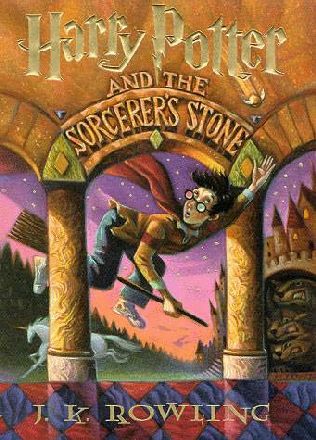
Image retrieved from http://www.fantasticfiction.co.uk/images/n1/n5584.jpg on 12 April 2008)

Saturday, March 1, 2008

"The Thief Lord"


After reading this novel, I feel like I have just been to Venice myself, without the jet lag. Mrs. Funke's imagery makes readers "see" the city and the actions of the characters; she makes the words jump right off the page.

This work definitely embodies the qualities of outstanding children's literature that we spoke of in class. Many passages expand awareness of Italy, such as the descriptions of "...the maze of alleys in which every visitor to Venice gets lost in at least once" (339), and her description of the horses and
winged lion in the Basilica, which actually exist there, as well as those of Venice itself, with its "houses on stilts, the roads made of water, [and] the lion's with wings" (132). She also made this work an enjoyable read by not overtly teaching. The aforementioned examples reference that, as do her lessons from Prosper throughout the book depicting his hesitance to steal, and the sporadic Italian words such as "Pronto" (145), as a way to detail how Italians answer the phone, and "Arrivederci" (239), as a way to say goodbye. These "mini-lessons" are not explicit, but are a part of the text and are lessons to be learned from this novel. Thirdly, this novel tells the truth of how humans would feel in certain situations. For example, Prosper and Bo run away so that they can stay together, which is a likely action to take as brothers. In addition, near the end of the novel, Scipio and Prosper want to grow up--Scipio so that he could control his own life, and Prosper so that he could become "...big and strong" (250). Throughout childhood we all have times when we want to become adults so that something in our lives will be different. In this way, Scipio and Prosper's feelings do reflect those of real children. This novel also embodies quality. One of my favorite descriptions in The Thief Lord was in Barbarossa's shop where "Riccio made faces at the masked lady smiling down at them from a large painting on the wall. This was his regular joke, for behind the lady's mask was a peephole through which Barbarossa kept and eye on his customers" (39). Mrs. Funke could have just said that Barbarossa spied on his customers, but instead she used vividly descriptive language so that readers could actually see the shop, the painting, and Barbarossa spying on his customers in their minds. Her descriptions show that this work does embody quality. This book also has integrity with a detailed and interesting plot set in Venice, Italy, well-developed characters that come alive in the reading, surprising plot-twists, and a remarkable writing style. Finally, this novel embodies originality, for example, I have not ever read a novel which detailed a story of an enchanted merry-go-round at an orphanage. All of these aforementioned aspects ensure that The Thief Lord embodies the qualities of a piece of outstanding children's literature.

I believe the most intriguing plot twist in this work to be when readers discover the truth about Scipio! I had thought all along that possibly he was not orphaned, especially since he did not sleep in the theatre, but I had not yet made the connection that he was so closely connected to the owner of the theatre, until I read that section of the book.

Mrs. Funke does a remarkable job of integrating fantastical elements into Venice. She incorporates the merry-go-round and the idea of being able to change from child to adult and vice versa into her real-world descriptions of the fantastic city of Venice. This incorporation makes the fictional parts of the story seem more real to readers simply because of the truthful descriptions of the setting.

In this novel there were also numerous connections to Carnival at Candlelight. Besides the setting in Venice, the most notable comparison was the lion imagery. From the very first pages of this novel, lions were prominent. There were lions in the story Prosper and Bo's mother told them of Venice, lions in Victor's office, lions in the Basilica, and Riccio even gave Bo a stuffed lion. Of course, the lion on the merry-go-round and it's wing were also critical aspects to the story.

The end of this novel left me with many questions, such as: How did Victor know that he had a meeting with Esther if she made the appointment while he was at the theatre? Even though Esther was so ready to break all connections with her nephews when she went to Ida's house, why did she not question that there was no sign indicating that that location was the orphanage? How did they fake the adoption papers for Barbarossa?

Even though I had several questions after reading this novel, I thought the overall story was very exciting and I believe that many fifth graders would enjoy reading it.
(Image retrieved from http://www.kidsreads.com/art/covers/0439404371.jpg on 19 April 2008)

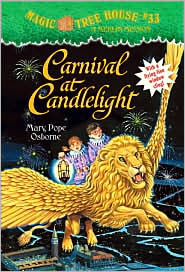
"Carnival at Candlelight"


Carnival at Candleight
Written by: Mary Pope Osborne
Illustrated by: Sal Murdocca
Published by Random House Children's Books in 2005 in NY
Genre: Fantasy
Ages: Grades 2-4

Before reading "Carnival at Candlelight" I had not ever read any books in the magic tree house series; however, now I cannot wait to read more of them and eventually incorporate them into my classroom! What I loved most about this book was that it was more than just a fantasy novel for children, it also had many interesting facts about the city of Venice, Italy. I believe that the incorporation of such facts in a book of this type is a great way to teach students about a place they have never been without utilizing traditional methods of teaching.

One thing that I found most interesting about this book was that even the context of the story teaches children. Possibly because "Jack loved maps" (27), that might spark an interest in the same thing in a child reading this book. This book also teaches about patience because Jack's sister Annie continuously reminds him to exercise patience in their journey. Even though Jack is very excited he has to remain calm so they can both complete the journey successfully. "Carnival at Candlelight" also teaches students to make wise choices, not imprudent ones since Jack and Annie must ration their magic so it lasts for four trips.

Besides the wonderful story by
Ms. Osborne, this story holds the interest of its readers because even from the first two pages, readers become aware that after this story, there are still three more missions to come for Jack and Annie before they know whether they will be able to use magic on their own! Not only does "Carnival at Candlelight" begin by grasping the interest of its readers, but at the end of the story Jack shares a remarkable discovery, making readers very excited that the next few books in the series could reveal if Jack's suspicions are correct!

As far as a lesson plan idea with this book, I think it could be used to enlighten students of customs in other parts of the world, to teach about a very famous ancient city, famous artists, and to present students with an interesting story they want to read. I think this would be a great book to use in the classroom!